The 1960s were a turning point for compact German cars, with manufacturers refining small-displacement engines and practical bodies for everyday driving. On European roads and in private garages today, those models still show how engineering choices of the era balanced economy, simplicity, and durability.
There are 7 1960s Audi Models, ranging from Audi 60 (F103 variant) to DKW F102; for each entry you’ll find below the Production years, Body type, Engine (L), and a brief note on distinguishing features — you’ll find below.
How different were these models in size and performance?
The line-up spans small family cars to compact sedans: engine sizes are generally modest, so performance differences come down to tuning and body weight rather than big displacement gaps. Expect variations in top speed and acceleration, but more noticeable contrasts in interior space and intended use (city vs. longer-distance comfort).
Can I still source parts or get one serviced?
Yes — parts availability varies by model. Common items for F103-derived cars are relatively easy to find via specialist suppliers and enthusiast clubs; rarer DKW components sometimes require NOS parts, repros, or donor vehicles. Joining marque forums and local clubs is the fastest way to locate parts and trustworthy mechanics.
1960s Audi Models
| Model | Production years | Body type | Engine (L) |
|---|---|---|---|
| DKW 3=6 | 1960–1966 | sedan, estate | 0.9 L I3 two-stroke |
| DKW 1000/1000S | 1960–1965 | sedan, coupe | 1.0 L I3 two-stroke |
| Auto Union 1000 SP | 1960–1965 | coupe | 1.0 L I3 two-stroke |
| DKW F102 | 1963–1966 | sedan | 1.2 L V4 two-stroke (main) |
| Audi F103 (F103 series) | 1965–1969 | sedan | 1.5 L I4;1.7 L I4 |
| Audi 60 (F103 variant) | 1968–1969 | sedan | 1.5 L I4 |
| Audi 75 (F103 variant) | 1968–1969 | sedan | 1.7 L I4 |
Images and Descriptions
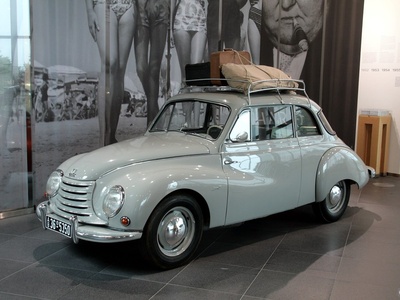
DKW 3=6
A key late-era DKW family car, the 3=6 (Sonderklasse) was a compact sedan and estate with a 0.9 L two‑stroke three-cylinder. It represented the end of DKW’s two‑stroke mainstream lineup and was popular in export markets.

DKW 1000/1000S
Small, economical four‑door sedans and sportier coupe variants, the 1000/1000S used a 1.0 L two‑stroke three‑cylinder and filled the entry market role for Auto Union in the early 1960s.
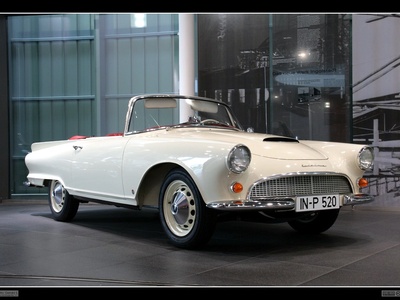
Auto Union 1000 SP
A stylish Italian‑designed coupe built on the 1000 platform, the 1000 SP combined elegant coachwork with the 1.0 L two‑stroke engine and became a niche halo model for Auto Union in the early 1960s.
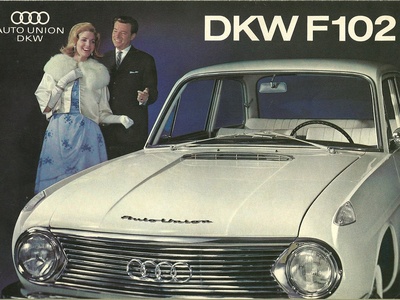
DKW F102
The F102 was Auto Union’s move toward modern mid‑sized cars, featuring a V4 two‑stroke engine and conventional sedan body. It was a transitional model that set the stage for Volkswagen’s later Audi revival.
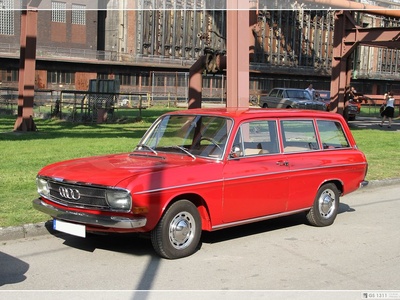
Audi F103 (F103 series)
After VW bought Auto Union, the F103 revived the Audi name with four‑stroke inline‑four engines. Sold through the late 1960s, it replaced two‑stroke DKWs and established Audi as a maker of conventional four‑stroke sedans.
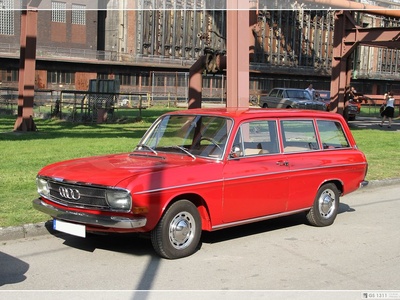
Audi 60 (F103 variant)
A budget version of the F103 family, the Audi 60 used a 1.5 L four‑cylinder and emphasized economy and simplicity. It marked Audi’s early efforts to broaden the range under VW ownership.
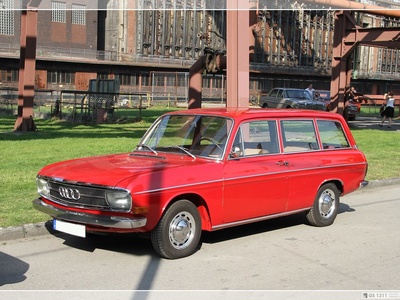
Audi 75 (F103 variant)
One of the higher‑output F103 variants, the Audi 75 offered a 1.7 L engine and slightly sportier tuning. It helped define Audi’s image as a more refined, performance‑oriented alternative to basic family cars.