1955 was the year Dodge stopped looking like your grandfather’s car. The dumpy, upright bodies that had carried the brand through the early ’50s were gone, replaced by Virgil Exner’s longer, lower “Forward Look” — a styling gamble Chrysler made while the whole corporation was bleeding market share. It worked. Dodge sales nearly doubled over 1954, and the cars from this single model year still pull crowds at shows seventy years later.
Most write-ups stop at the three car lines and call it a day. This one covers all of them — Coronet, Royal, Custom Royal, the pink-and-white La Femme, and the C-3 trucks almost everyone forgets Dodge built that same year — with the engines, body styles, and what each is worth now.
Table of Contents
- Fast Facts
- The Quick Verdict
- 1955 Dodge Coronet
- 1955 Dodge Royal
- 1955 Dodge Custom Royal
- 1955 Dodge La Femme
- 1955 Dodge Trucks (C-3 Series)
- Engines: The Red Ram Story
- Spec Comparison Table
- Buyer’s Notes: What to Inspect
Fast Facts
- Body lines (cars): Coronet, Royal, Custom Royal — plus the La Femme appearance package
- Wheelbase: 120 inches across the car range
- Engines: 230 cu in flathead six, plus 270 and 325 cu in “Red Ram” Hemi V8s
- Designer: Virgil Exner, the first full year of the “Forward Look”
- Trucks: C-3 series, ½-ton through heavy-duty, sold alongside the cars
- Why it matters: the styling rescue year that helped pull Chrysler back from a brutal 1954
The Quick Verdict
If you want the most car for the money and don’t mind a flathead six, a base Coronet sedan is the cheapest way into a 1955 Dodge. If you want the one collectors actually chase, it’s the Custom Royal Lancer hardtop — two-tone paint, the bigger Red Ram V8, and the cleanest expression of Exner’s lines. The La Femme is the trophy: rare, weird, and the only one of the bunch whose value comes from marketing history rather than horsepower. And the C-3 trucks are the sleeper play — undervalued, genuinely useful, and getting harder to find rust-free.
1955 Dodge Coronet
The Coronet was the floor of the lineup, and in 1955 the floor was a decent place to stand. This was the volume seller — the one that put Dodge in driveways across the country and a fixture among the era’s classic American sedans — so survivors aren’t rare, which keeps prices reasonable.
Body styles ran the full spread: two- and four-door sedans, the Lancer two-door hardtop, a convertible, and the Suburban wagons in two- and four-door form. You could get the Coronet with the 230 cubic inch flathead six or step up to the 270 Red Ram V8, which is the smarter long-term buy if you plan to actually drive it on modern roads.
Original base price sat around $2,000 for a six-cylinder sedan. Today a driver-quality Coronet sedan trades in the $10,000–$20,000 range, while a clean V8 convertible can push past $40,000. The sedans are where the bargains live — same lines, same year, a fraction of the hardtop’s price.
1955 Dodge Royal
The Royal was the middle child, and like most middle children it gets overlooked. That’s the opportunity. It came standard with the V8 — no flathead six option here — so even an entry Royal gives you Hemi power, and it carried nicer interior trim and brightwork than the Coronet without the Custom Royal’s premium.
The Lancer hardtop is the body style to want. It’s the same pillarless roofline as the more expensive cars, with two-tone paint schemes that show off the Forward Look’s length. Royals tend to slot below comparable Custom Royals by several thousand dollars, which makes a Royal Lancer one of the better value-to-style ratios in the whole 1955 catalog. Figure $18,000–$35,000 for a solid hardtop depending on engine and restoration quality.
1955 Dodge Custom Royal
This is the flagship, and it’s the 1955 Dodge most people picture — and it earned its spot among the most popular cars of 1955. The Custom Royal got the top trim, the most chrome, and the largest engine — the 325 cubic inch Red Ram V8 making up to 193 horsepower in its hottest tune.
The standout is the Custom Royal Lancer hardtop, often finished in three-tone paint that’s become a signature of mid-’50s Mopar styling. There was also a Custom Royal convertible, the rarest and priciest of the regular production cars. Original prices ran near $2,500–$2,700. Now a well-restored Custom Royal Lancer hardtop commonly lands in the $30,000–$55,000 band, and a documented convertible can clear $70,000 at the right auction. The Lancer hardtop is the sweet spot: maximum visual drama, far more attainable than the drop-top.
1955 Dodge La Femme
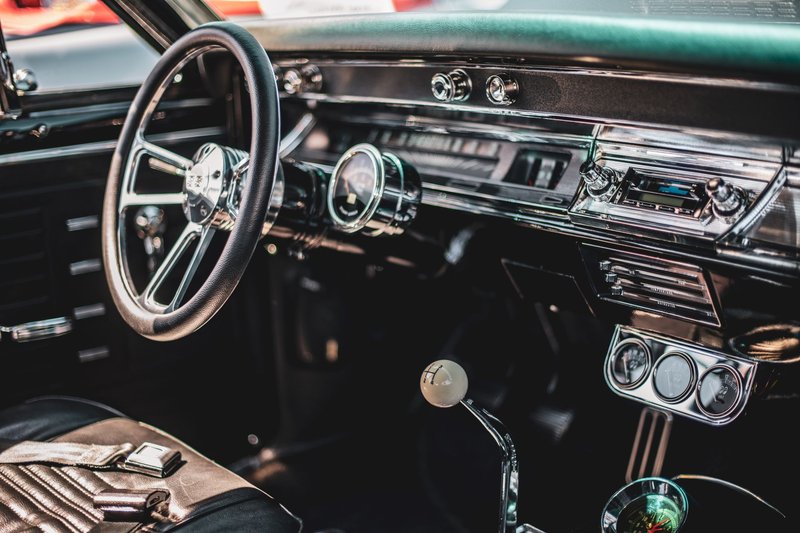
Here’s the one nobody else explains properly. The La Femme wasn’t a separate model — it was an option package on the Custom Royal Lancer hardtop, and it was marketed explicitly to women, a genuinely unusual move in 1955. Dodge dressed it in a two-tone “Heather Rose and Sapphire White” paint scheme, fitted rosebud-pattern upholstery, and included a matching set of accessories: a calfskin handbag, a compact, a lighter, a cigarette case, and even a folding umbrella stowed in a special door pocket.
It flopped commercially. Production was tiny across its two-year run, which is exactly why it’s coveted now. A complete La Femme with its original accessories is a six-figure conversation — values commonly run $80,000 to well over $100,000, with the accessory kit alone worth thousands if it’s intact. Treat any car claiming to be a La Femme with the same skepticism you’d bring to any high-value option car: verify the paint code, the trim, and ideally documentation, because the package is easy to fake and expensive to get wrong.
1955 Dodge Trucks (C-3 Series)
The cars get the magazine covers, but Dodge built trucks the same year, and the 1955 C-3 series is the part of the lineup almost every car-focused article skips. The C-3 was a mild refresh of the “Job-Rated” trucks, spanning the ½-ton C-3-B up through bigger ¾- and 1-ton haulers and on into heavier commercial rigs.
These came with flathead sixes in most light-duty trims, with the Power Dome and later Hemi V8 options appearing in the range as the mid-’50s progressed. Mechanically they’re simple, parts-friendly, and tough — the reason so many ended up working farms and job sites until they wore out.
For collectors, that toughness cuts both ways: plenty were used hard and scrapped, so a rust-free, original C-3 pickup is harder to find than the production numbers suggest. Values are still reasonable — a solid driver ½-ton runs $15,000–$30,000, with restored or custom builds going higher. As a buy-now angle, the C-3 is the most overlooked 1955 Dodge there is — a refreshing detour from the classic American cars that usually soak up collector attention.
Engines: The Red Ram Story
The 1955 Dodge powertrain story is really the story of the Red Ram Hemi. Dodge’s version of Chrysler’s hemispherical-head V8 was smaller than the big Chrysler and DeSoto Hemis, but it punched above its displacement thanks to the breathing efficiency of the hemi combustion chamber.
Three engines covered the range:
- 230 cu in flathead six — the economy base in the Coronet, smooth and durable but slow
- 270 cu in Red Ram V8 — the volume V8, standard in the Royal and optional in the Coronet
- 325 cu in Red Ram V8 — the top engine in the Custom Royal, up to roughly 193 hp in its strongest state of tune
If you’re buying to drive rather than to park, the V8 cars are worth the premium. The flathead six is charming and reliable, but it was built for 1955 traffic, not 2026 on-ramps. The hemispherical-head design Chrysler pioneered in this era is the same basic idea that made the brand’s later performance reputation — the Hemi engine lineage that car people still argue about today traces straight back through these Red Ram units.
Spec Comparison Table
| Model | Standard engine | Top engine | Key body styles | Typical value (driver→top) |
|---|---|---|---|---|
| Coronet | 230 I6 flathead | 270 Red Ram V8 | Sedan, Lancer hardtop, convertible, Suburban wagon | $10k → $40k+ |
| Royal | 270 Red Ram V8 | 270 Red Ram V8 | Sedan, Lancer hardtop | $18k → $35k |
| Custom Royal | 270 Red Ram V8 | 325 Red Ram V8 | Lancer hardtop, convertible, sedan | $30k → $70k+ |
| La Femme | 325 Red Ram V8 | 325 Red Ram V8 | Custom Royal Lancer hardtop (package) | $80k → $100k+ |
| C-3 truck | 230-class flathead six | V8 options | ½-ton pickup, ¾/1-ton, commercial | $15k → $30k+ |
Values are general guidance for the current collector market and swing hard on condition, documentation, and originality.
Buyer’s Notes: What to Inspect
A 1955 Dodge is a seventy-year-old car, and the styling that makes it gorgeous also makes it expensive to fix when it’s wrong. Before you buy:
- Rust in the usual places — floors, trunk pan, lower fenders, rocker panels, and around the windshield. The Forward Look’s body trim hides seams where moisture collects.
- Two- and three-tone paint — correct color separation and trim is hard and pricey to redo properly. Sloppy two-tone work is a tell that the rest of the restoration was rushed.
- Engine originality — confirm whether the V8 is the correct Red Ram for the model. Engine swaps are common and affect value.
- Trim and brightwork — these cars carried a lot of chrome and stainless. Missing or pitted pieces are findable but add up fast.
- For a La Femme — verify the paint, upholstery pattern, and the accessory kit, and ask for documentation. The premium lives entirely in authenticity.
- For a C-3 truck — check the bed, cab corners, and frame. Work trucks lived hard lives.
The 1955 model year is the one where Dodge got interesting again, and the range is wide enough that there’s a version for almost any budget — a few thousand dollars for a project Coronet sedan, six figures for a documented La Femme. Buy the best condition you can afford in the body style you actually love, because with these cars the restoration always costs more than the car. For market comparisons and recent sale prices, the public listings at JD Power’s classic car values are a reasonable place to sanity-check whatever a seller is asking.

Marco Delantero
More from Marco DelanteroHow we reviewed this article
This article was researched against manufacturer records and editorially reviewed before publishing. We accept no payment for coverage. Some guides contain affiliate links; see our affiliate disclosure.