The 1950s are where Lotus actually became Lotus. Not the supercar brand, not the F1 dynasty — a guy named Colin Chapman building lightweight specials in a stable behind a North London pub, figuring out that the fastest way around a corner was to throw weight away rather than add power. Every Lotus that followed traces back to a handful of cars built between 1952 and 1959.
The problem with researching these is that most lists bury them inside a 1948-to-present mega-table, give the road cars one line, and link to image thumbnails that broke years ago. So here’s the clean version: every 1950s Lotus, in order, with what made each one matter.
Table of Contents
- The quick reference table
- Mark IV (1952)
- Mark VI (1953) — the first real product
- Mark VIII, IX & X (1954-55) — the streamliners
- Eleven / Type 11 (1956)
- Type 12 (1957) — into single-seaters
- Seven / Type 7 (1957)
- Elite / Type 14 (1957) — the fibreglass leap
- Type 16 & 18 (1958-59) — Formula 1 arrives
- Why these cars still matter
The quick reference table
| Model | Year | Type | Engine | Notable for |
|---|---|---|---|---|
| Mark IV | 1952 | Trials car | Ford sidevalve | Last of the pre-production specials |
| Mark VI | 1953 | Kit sports car | Ford / Coventry-Climax | First car sold to the public |
| Mark VIII | 1954 | Sports racer | MG / Coventry-Climax | First aerodynamic body |
| Mark IX | 1955 | Sports racer | Coventry-Climax FWA | First Lotus at Le Mans |
| Mark X | 1955 | Sports racer | Bristol 2.0L | Big-engine version of the IX |
| Eleven (Type 11) | 1956 | Sports racer | Coventry-Climax FWA/FWB | Index of Performance, Le Mans |
| Type 12 | 1957 | Single-seater | Coventry-Climax FPF | First Lotus open-wheeler |
| Seven (Type 7) | 1957 | Road/club racer | Ford / Coventry-Climax | Still in production today (as the Caterham) |
| Elite (Type 14) | 1957 | GT coupe | Coventry-Climax FWE | First fibreglass monocoque road car |
| Type 16 | 1958 | F1/F2 | Coventry-Climax | First Lotus Grand Prix car |
| Type 18 | 1959 | F1/F2/F3 | Coventry-Climax | First mid-engined Lotus; first GP win (1960) |
Mark IV (1952)
The Mark IV closes out Chapman’s amateur period. It was a trials car — a uniquely British discipline where you drive a lightweight special up a muddy hill and try not to stop — built on a modified Austin Seven chassis with a tuned Ford sidevalve engine.
It never went into production and only one was built. Its importance is what came next: by 1952 Chapman had registered Lotus Engineering Company and was about to stop building one-offs for himself and start selling cars to other people. The Mark IV is the last car of the hobby; the Mark VI is the first car of the business.
A note on the numbering, because it trips everyone up: there was never a “Mark V.” Chapman planned a car, the design didn’t happen, and he skipped the number rather than reuse it. So the sequence runs IV, VI, VIII — with gaps that aren’t mistakes.
Mark VI (1953) — the first real product
This is the one that started the company you know. The Mark VI was Lotus’s first production car, sold as a kit so buyers could dodge the UK’s purchase tax on completed vehicles. You bought a chassis, an aluminium body, and the suspension pieces, then sourced your own engine and gearbox.
The chassis is the whole story. It was a multi-tubular spaceframe — a lattice of small steel tubes triangulated so that every member carries load in tension or compression rather than bending. The result weighed around 55 pounds bare and was stiff enough that the aluminium body panels added rigidity too. Most owners fitted a Ford sidevalve or a Coventry-Climax unit; output varied wildly because the buyer chose the engine.
Roughly 100 were built between 1953 and 1955. That sounds small, but it was enough to prove the model: sell a lightweight, race-ready chassis to enthusiasts, let them campaign it on weekends, and let their results become your marketing. The Mark VI’s direct descendant arrived in 1957 — the Seven — and that one never really stopped.
Mark VIII, IX & X (1954-55) — the streamliners
Here’s where Chapman started caring about air. The Mark VIII (1954) was the first Lotus with a fully aerodynamic body, shaped with input from aerodynamicist Frank Costin (whose brother Mike would later co-found Cosworth). The envelope bodywork — fully enclosed wheels, a long tapering tail — was radical for a small British sports racer in 1954, and it worked: the VIII famously beat a works Porsche 550 at Silverstone. Beating an established marque with a featherweight special was the kind of result that put Lotus alongside the other classic British cars that defined the era’s sports-racing scene.
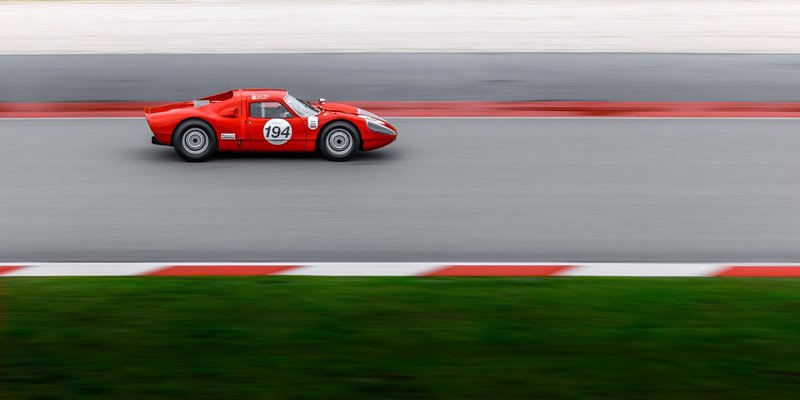
The Mark IX (1955) refined the formula and switched to the new Coventry-Climax FWA, a 1,098cc overhead-cam four that had started life as a fire-pump engine. Lightweight, willing to rev, and reliable, the FWA became the engine that powered Lotus through the back half of the decade. The IX was also the first Lotus entered at the 24 Hours of Le Mans, in 1955 — though it was controversially disqualified for reversing in the pit area.
The Mark X (1955) was essentially a IX built around a larger 2.0-litre Bristol straight-six for buyers who wanted more torque for longer circuits. Small production numbers, but it filled out the range while the FWA-powered cars handled the lightweight classes.
Eleven / Type 11 (1956)
The Eleven is the car where the 1950s racing program clicked. Around 270 were built — a huge number by Lotus standards — and it became the dominant small-capacity sports racer of its era. Frank Costin’s body was slipperier than anything before it, the spaceframe was lighter, and depending on the variant it ran the 1,098cc Coventry-Climax FWA or the 1,460cc FWB.
What the Eleven actually won tells you more than spec sheets. At Le Mans in 1956 and 1957, Elevens took the Index of Performance — a handicap award rewarding distance covered relative to engine size, which was effectively the trophy for being the most efficient car in the race. That’s the whole Chapman thesis stamped onto a result: don’t out-power them, out-engineer them. Stirling Moss and others set class records and took a string of international class wins in Elevens through 1956 and 1957.
If you want to understand why Lotus mattered before it ever built a road-car empire, this is the car to point at. You can read Classic Team Lotus’s own account of the early years for the in-period detail, since they’re the keepers of the works history.
Type 12 (1957) — into single-seaters
The Type 12 was Lotus’s first open-wheel single-seater, built for Formula 2 in 1957 and later run in Formula 1 trim. It introduced two pieces of Chapman thinking that would define the marque.
First, the “wobbly-web” cast-alloy wheel — a one-piece aluminium wheel with a wavy, ribbed web instead of spokes, lighter and stiffer than the wire wheels everyone else used. Second, a new rear suspension layout that used the driveshaft as an upper locating link, later nicknamed the “Chapman strut.” Neither was perfect out of the box (the early transaxle was fragile), but both showed Chapman attacking the single-seater problem the same way he’d attacked sports cars: through the chassis and the unsprung weight, not the engine.
Seven / Type 7 (1957)
The Seven is the most famous thing on this list, and it’s famous for refusing to die. Launched in 1957 as a road-legal, club-racing kit car, it took the Mark VI idea — minimal spaceframe, cycle or clamshell wings, no bodywork you didn’t need — and made it a product you could buy for decades.
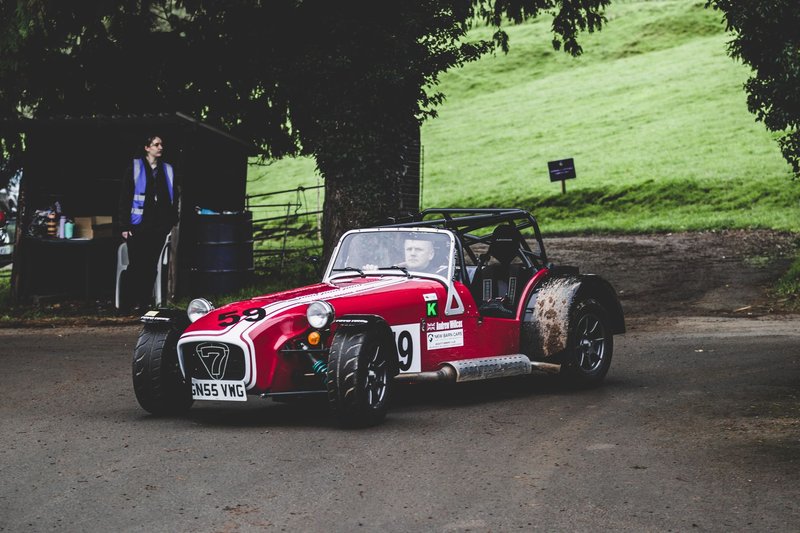
Early Series 1 cars used a spaceframe with stressed aluminium panels, live rear axle, and a choice of Ford or Coventry-Climax power, with kerb weights down around 1,000 pounds. The driving experience was the point: no doors worth speaking of, your elbow over the side, steering that reacts before you’ve finished thinking. When Lotus stopped building it in 1973, Caterham Cars bought the rights and has built it continuously ever since — which makes the 1957 Seven the oldest car design still in production in anything close to its original form. (Yes, that’s also the car from the opening titles of The Prisoner.)
Elite / Type 14 (1957) — the fibreglass leap
The Elite is the technical high-water mark of the decade and arguably the most ambitious small car anyone attempted in the 1950s. It was the first production road car with a fibreglass monocoque — meaning the glass-reinforced plastic shell wasn’t just bodywork bolted to a frame, it was the structure. Steel was added only where loads concentrated: a subframe at the front for the engine and suspension, a hoop around the windscreen, mounting points at the rear.
The payoff was a closed GT coupe that weighed about 1,100 pounds and slipped through the air with a drag coefficient around 0.29 — a figure plenty of modern cars still can’t match. Power came from a 1,216cc Coventry-Climax FWE, and the Elite went on to win its class at Le Mans multiple times across the early 1960s.
The catch was the same as the ambition. Fibreglass monocoque construction was new, hard to get consistent, and expensive to build, and Lotus reportedly lost money on every Elite it sold. It’s the car that proved Chapman could out-engineer the establishment and also the car that taught him a road model has to make money, not just headlines — a lesson that shaped the simpler, steel-backbone Elan and the rest of the 1960s Lotus car models that replaced it.
Type 16 & 18 (1958-59) — Formula 1 arrives
The decade ends with Lotus walking into Grand Prix racing. The Type 16 (1958) was the first Lotus F1 car, essentially a scaled-up Type 12 with a front-mounted Coventry-Climax engine canted over to lower the bonnet line. It was beautiful, fragile, and fundamentally on the wrong side of history — because the front-engine layout was about to be obsolete.
The Type 18 (1959) is the one that mattered. It was the first mid-engined Lotus, putting the Coventry-Climax behind the driver in a simple, light, boxy spaceframe — no aerodynamic vanity, just a package that worked. The 18 was versatile enough to run in F1, F2, and F3 with engine swaps, and in 1960 it gave Lotus its first Championship Grand Prix victory when Stirling Moss won at Monaco for Rob Walker’s privateer team. The mid-engine revolution that the 18 rode wasn’t Lotus’s invention, but Chapman read it faster and lighter than almost anyone, and the Formula 1 history record treats this car as the start of the team’s serious championship era.
Why these cars still matter
Run the decade back as one line and the pattern is obvious. Mark IV: a hobby ends. Mark VI: a business starts, built on a spaceframe so light it embarrassed cars twice its price. The streamliners and the Eleven: prove the whole philosophy at Le Mans by winning on efficiency instead of power. The Seven: turn that philosophy into a product that outlives its creator. The Elite: push it too far and learn the cost. The Type 18: carry it into Formula 1 and win.
There was no “Lotus formula” handed down from above — Chapman invented it in real time across these eleven cars, mostly by removing things other manufacturers thought were essential. Every modern Lotus, and a fair chunk of every modern racing car, is still arguing with the conclusions he reached in a stable behind a pub. That’s why a list of 1950s Lotus models reads less like a catalog and more like the opening chapter of how lightweight engineering took over motorsport.

Marco Delantero
More from Marco DelanteroHow we reviewed this article
This article was researched against manufacturer records and editorially reviewed before publishing. We accept no payment for coverage.